Featured News

Know Your Rights Workshop

Come learn about your rights and what to do when interacting with police officers and immigration agents. Organized by Foothill Fire & hosted by UUCM’s Justice Team. Thanks to Norcal Resist for making this event possible!

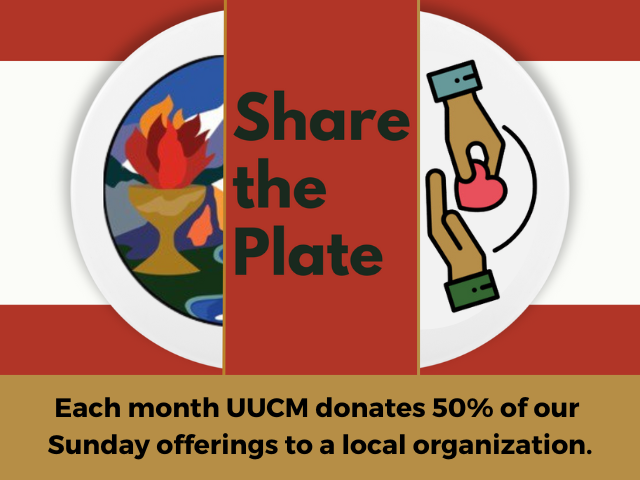
Share the Plate

UUCM’s January Share the Plate recipient, Sierra Roots, will receive $1,172, thanks to generous UUCM members, friends, and visitors.  These weekly donations add up.  Thank you all.

As of this writing, we are currently finishing up collections for our February partner, Community Beyond Violence.

Our March Share the Plate recipient is Interfaith Food Ministry – Feed Families, Fueling Hope.

Interfaith Food Ministry has been providing supplemental food as a 501(c)(3) non-profit in Western Nevada County since 1987. Over those 35 years, 1,000,000 seniors, families with children, and single adults have walked through our doors. Several UUCM members and friends volunteer regularly at IFM, including the UUCM work group, which volunteers at IFM the second Tuesday of every month.

 Thank you, each of you, for your continual compassion and justice centered generosity.

Structure + Choice = Trust

Our Kids’ Connection program has an intentional design, one that is consistent with our goal of promoting feelings of TRUST in our young charges. One overarching design principle that permeates our program is best captured in the phrase CHOICE WITHIN STRUCTURE. Competing philosophies of education often are geared toward one or the other of those two constructs—choice or structure. In contrast, we believe that choice and structure are symbiotically significant in the ways that they help children develop trust in themselves, as well as in the people and practices that constitute our Kids’ Connection program.

Let’s start with STRUCTURE. Structure gives our program a recognizable and predictable form. When children can predict how each Sunday morning will unfold, they learn to trust the program and the people who run it. When new children join us, they are understandably unsure of themselves. They do not yet trust that this experience will be a positive one. But after they have visited with us a few times, we see them quickly getting involved by collaboratively building our altar, sharing a joy or sorrow, creating a pretend meal in our kids’ kitchen, or making a piece of art at our table full of art supplies. Routines and rituals, by their very nature, are repeating, allowing children to understand on their own what is expected of them and how to fit in. This ability to figure out on their own how to operate within the inherent structure promotes in our children a trust in their own abilities. Even when the routines and rituals are not ones a child particularly enjoys, the fact that they are predictable helps them cope with the challenge of getting through the activity successfully. Many, many decades ago, when I was teaching high school English, a particularly challenging student said to me with a defiant tone, “I really hate these vocabulary assignments you give us.” Then, a brief moment later, his defiance shifted to a tone of acceptance when he said, “but they only come on Wednesdays and I can live with that.” He trusted me, my instructional program, and himself because he knew the routines surrounding those undesirable vocab assignments. Imagine how much more threatening those assignments would have been if he had not known when they were likely to pop up.

Now for CHOICE, what is its contribution to fostering children’s trust in themselves, us, and our program? Structure is a foundational element in our program. Without it, or with an insufficient amount of it, the children’s experiences in the program would be some version of chaotic.

Chaos does not promote trust. But by itself, structure can also be limiting. We want our children to build on the trust that structure promotes by taking ownership of their experiences in Kids’ Connection, pursuing their own interests, expressing their own thoughts, creating their own pieces of art or scenarios for play. When children make choices about how to operate within a thoughtfully provided structure, they learn to trust their own agency.

One ritual activity in our Kids’ Connection program that provides many opportunities for the children to make meaningful choices within a well-articulated structure happens immediately when we enter Our Sanctuary upstairs. The first experience of the day is building our altar.

This activity is well structured. It must be the first activity of the day in order for the following activities to have a space to play out. There are a few basic rules to follow in that certain ritual pieces are always displayed on the altar, although where exactly they are placed is open for the children’s determination. Beyond those few ritual pieces that always go on the altar, however, the options for decorating the altar are wide ranging. Our altars are like snowflakes—no two are ever alike. Watching the children decorate the altar with their specific choices is like gaining a little window into their minds and hearts. Some of them are fascinated by the light of the candles and battery operated, mini-chalice flames. Some of them want the surface of the altar to be covered with stars and stones and beads and shells. Some of them like to place on the altar larger, more sculptural items from nature like pinecones and feathers. Some are fascinated by and want to play with the water we pour into the vessel for our joys and sorrows stones. Our children make their own choices for the altar, place those choices carefully and strategically on the altar, and then step back to appreciate how their contributions helped to create this important part of our UU ritual. This adds to their sense of trust. They trust that

they are important to us and that their ideas and creations are important to us. . We trust them to be our co-creators of the Kids’ Connection program. This is a bi-directional form of trust that is meaningful and genuine, for children and adults alike.

Examples of how CHOICE WITHIN STRUCTURE permeate our Kids’ Connection program are too numerous to begin to catalogue for you here. Suffice it to say that structure and choice are two defining features of our Kids’ Connection program and taken together they are greater than the sum of their parts. You can TRUST me on that!!

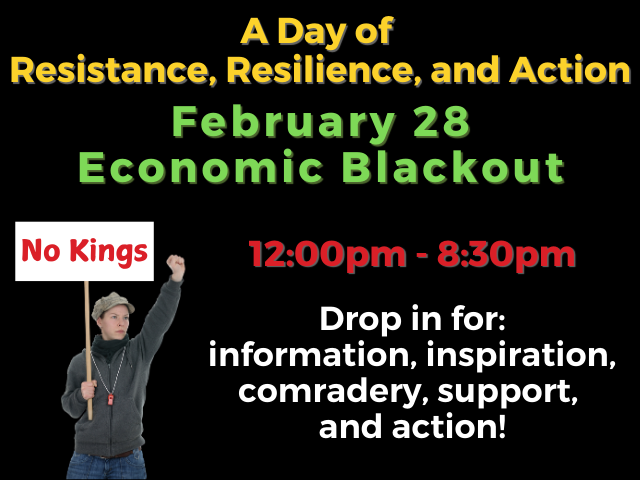
A Day of Resistance, Resilience, and Action

UUCM will be open from 12:00pm -8:30pm to support your needs in solidarity with the 24-hour Economic Blackout. You are invited to come. Bring food to share or not.

 This drop in event of overlapping activities includes :

continuous videos full of inspiration, information, strategies, uplifting videos to recharge your heart and soul.

facilitated conversation circles

peer support

political action activities : protest sign making, postcards, phone banking

music

social action book swap

No Kings resource table

arts and crafts circle

drum circle

meditation room

and more!

For questions or to volunteer at the event, please contact BendingTheArc@uugrassvalley.org.

More about the Economic Blackout
Friday, February 28th from 12:00 AM to 11:59 PM

WHAT NOT TO DO:

Do not make any purchases

Do not shop online or in stores

No Amazon, No Walmart, No Target, Nowhere!

Do not spend money on:

Fast Food

Gas

Major Retailers

Do not use Credit or Debit Cards for non-essential spending

WHAT YOU CAN DO:

Only buy essentials that are absolutely necessary
(Food, Medicine, Emergency Supplies)

If you must spend, ONLY support small, local businesses.

SPREAD THE MESSAGE
Talk about it, post about it, and document your actions that day!

WHY THIS MATTERS:
~ Corporations and banks only care about their bottom line.
~ If we disrupt the economy for just ONE day, it sends a powerful message.
~ If they don’t listen (they won’t),
       we make the next blackout longer (we will).

For more information, go to the People’s Union USA, a fledgling non-partisan organization with support from a broad coalition of activist groups.

The Silence Slips In

What is silence? And how is silence related to listening? While not exactly the same thing, silence and listening do overlap each other. Maybe one definition of silence could be eliminating the noises or sounds that we make so that we can take note of, or listen to, noises or sounds that we are not making. Sometimes those noises come from outside of ourselves— such as winds howling, dogs barking, or friends talking. But we can also listen to those ephemeral visitors in our consciousness that come, unbidden—the nearly constant flow of feelings, thoughts, memories that arise, stay awhile, and dissipate, all on their own.

So why all this focus on silence? Well, in Kids’ Connection on Sunday mornings, I am planning to include more opportunities for the children to learn about, experience, even play with the concept of silence. We have already incorporated a kid-friendly meditation experience that introduces the concept of silence. We all sit, with one hand raised in the air. Then, we play an extended sound—a chime—that lasts for about ten seconds before fading away. We keep our hands in the air until we cannot hear the sound anymore. Interestingly, the hands come down one at a time. Finally, we attempt to extend that moment of silence after the chime ends. The operative word there is “attempt.” I like this meditative sequence because it starts out with silence brought on by listening to sounds from our physical environment (the chime) and ends with an opportunity to shift our listening to noises from our psychological environment (our thoughts, feelings, memories).

A few weeks ago, after completing this meditative exercise, I read the children a book entitled The Silence Slips In by Alison Hughes and Ninon Pelletier. In this book, silence is somewhat anthropomorphized. It has a face and ears—although it looks more like a giant bunny than a human being. This larger, cloud-like being with a face and ears drifts into various situations that call for silence (e.g., bed time, moments of frustration, time for cuddling with a dog). When the silence slips in, the imposing, green being with a face, known as Noise, steps out of the picture to make room for Silence. This is a lovely book that makes a clear statement about how silence and noise move back and forth, taking turns, throughout our days, throughout our lives.

My hope is to build gradually the children’s understandings about what silence is and how it can be valuable for individuals and groups of people to know when and how to let silence slip in.

Deep Dialogue Workshops

How do we repair connections across seemingly irreconcilable differences and unresolved hurt feelings? Do we have to simply accept the loss of relationships – actual or possible – cutting the world into smaller and smaller slices of the people we can relate to? Our faith as Unitarian Universalists calls us to another, far more hopeful and inclusive way. The path is available to anyone bringing curiosity and goodwill!

UU History with Rev. Kevin

UU History is a 6-session introduction to concepts and people from our history. In this series, we’ll approach history from the starting point of compelling stories and personalities. The overarching question is: how can history be translated into our religious life and practice? In addition to learning about history, we hope you will learn about yourselves.

Organics ‘Recycling’ at UUCM!

Beginning January 6, 2025, Waste Management of Nevada County began collecting organic waste (compost) curb-side! 

What does this mean for UUCM?

All food scraps (including tea bags, citrus, & even bones!) and food-soiled, non-waxy paper & boxes must be collected separately from trash and recycling – look for the compost pail at Sunday social hour!

We will need a small group of volunteers to make sure this pail gets emptied into our large curbside bins throughout the week and after Sunday services or other events where food was served.

The amount of trash UUCM sends to the landfill will be drastically reduced! Hooray!

Questions?  Contact the office at admin@uugrassvalley.org.

Strategic Planning Workshop

The Strategic Planning Committee is newly formed and charged by the Board of Directors with preparing a 2025-2030 plan in the coming year. This fiveyear plan will be the touchstone against which we prioritize and support our activities in pursuit of our mission. This plan is an effort to be done by the Committee in conjunction with input from activity groups and the congregation at large – we need to hear what’s important to you! […]

Starting Point

If you’re interested in learning more what we do here at UUCM or what Unitarian Universalists actually believe and do, we encourage you to sign up for our next Starting Point series! Over five rich sessions of connection, exploration, and learning, you’ll have a chance to experience Unitarian Universalism, with awareness that each person brings important insight, experiences and perspectives to this shared journey. […]